
How Water Heaters Work
A storage water heater is a simple machine doing one thing continuously: keeping a tank of water at a set temperature so it is ready when you open a tap. Understanding the handful of parts involved makes hot water complaints far easier to describe and much easier to diagnose.
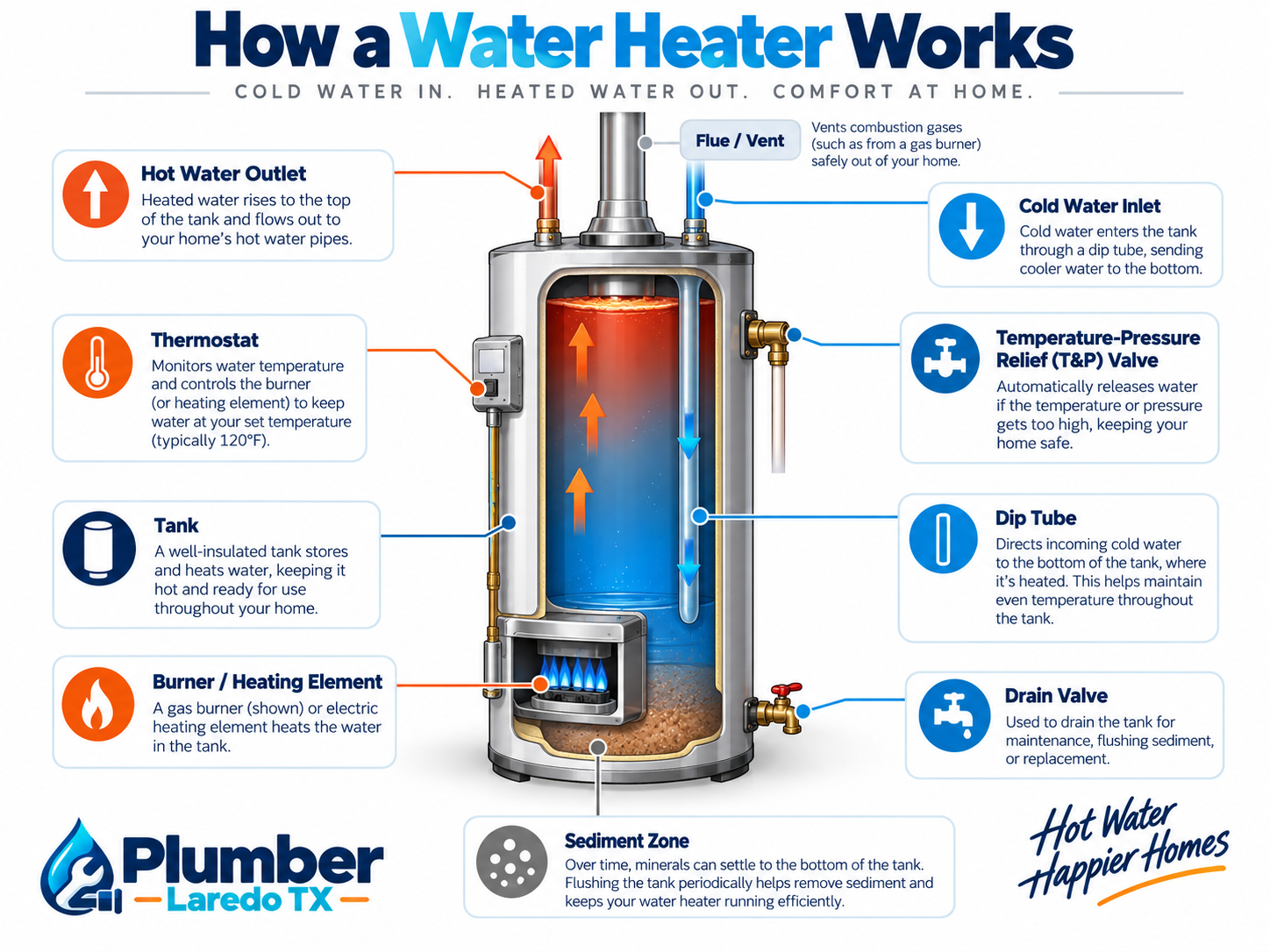
The cycle, start to finish
Cold water enters at the top and travels down the dip tube to the bottom of the tank, where the heat source is. As it warms, it rises, so the hottest water collects at the top — exactly where the outlet draws from. The thermostat watches the temperature and switches the element or burner on when it falls below the setting.
When you open a hot tap, water leaves from the top and cold water enters at the bottom to replace it. That is why a heater delivers hot water first and progressively cooler water as the tank depletes, and why recovery rate matters as much as tank size.
Two things quietly working against it
Sediment settles on the tank floor and insulates the heat source from the water above, costing capacity and efficiency. Meanwhile the anode rod corrodes on purpose, protecting the steel tank. When the rod is used up, the tank starts corroding instead, and that process ends with a leak that cannot be repaired.
Component by component
What each part does
Ten parts account for nearly every hot water complaint people report.
Cold water inlet
Cold water enters at the top of the tank, usually through a valve that lets the heater be isolated from the rest of the plumbing. That valve is what gets closed first when a heater leaks.
Dip tube
The inlet feeds a tube that carries cold water down to the bottom of the tank, so it does not mix with the hot water waiting at the top. A cracked dip tube causes sudden loss of usable hot water.
Heat source
Electric units use immersion elements; gas units use a burner beneath the tank. Either way, heat is applied at the bottom, where the incoming cold water arrives.
Thermostat
The thermostat measures tank temperature and switches the heat source on and off. Electric heaters typically have an upper and lower thermostat, plus a high-limit reset.
Hot water outlet
Hot water is drawn from the top of the tank, where it naturally collects. That is why a heater delivers hot water first and cooler water as the tank depletes.
Temperature and pressure relief valve
A safety device that opens if temperature or pressure exceeds safe limits, discharging through a pipe. A valve that repeatedly discharges is reporting a problem, not malfunctioning.
Drain valve
A valve at the base for draining and flushing the tank. It is how sediment gets removed and how a tank gets emptied before replacement.
Sediment
Minerals settle out of heated water and collect on the tank floor, insulating the heat source from the water above. That produces rumbling, reduced capacity, and extra strain.
Anode rod
A sacrificial rod that corrodes so the steel tank does not. Once it is spent, the tank begins corroding, which is what eventually causes a tank to leak.
Venting
Gas-fired equipment must exhaust combustion gases safely through appropriate venting. Venting work is not a homeowner task and is not something to modify.
Where to go from here
Something is wrong now
No hot water, lukewarm delivery, tank noise, or a leak from a fitting.
Water heater repairTime to replace it
A leaking tank, repeated repairs, or capacity that no longer matches the household.
Water heater installationConsidering tankless
No storage limit, different requirements, and descaling as ongoing maintenance.
Tankless water heatersSafety around water heaters
Do not open access panels on an electric heater with power on, and do not work on gas piping, burners, or venting. If you smell gas, leave the property, avoid switches and flames, and contact the gas utility or emergency services from a safe location. Never cap or block a relief valve that is discharging.
Water heater questions
- Why does hot water come out first and then run cold?
- Hot water is drawn from the top while cold water enters at the bottom through the dip tube. As you draw, the boundary rises, and once it reaches the outlet the water leaving is no longer fully heated.
- What does the relief valve actually protect against?
- Excess temperature or pressure inside the tank. If it discharges repeatedly, something upstream is wrong — often thermal expansion or a thermostat fault — and capping it is never the answer.
- Why does flushing the tank matter?
- Sediment on the tank floor sits between the heat source and the water, so the burner or element works harder for less result. Flushing removes it, quiets rumbling, and reduces strain.
- How does a tankless unit differ?
- There is no reservoir. Water is heated as it flows, so output is limited by gallons per minute rather than stored volume, and scale management through periodic descaling replaces tank flushing.
- What makes a tank finally fail?
- Internal corrosion, usually after the anode rod has been depleted for some time. When the steel gives way, water escapes from the tank body, and no external repair can seal that.
Need plumbing help in Laredo?
Tell us what you're dealing with and your request will be reviewed for availability.