
How Home Plumbing Works
Residential plumbing is two systems sharing a building. One arrives under pressure and delivers clean water where you want it. The other relies on gravity and air to carry waste away. Almost every household plumbing problem is easier to describe once you can picture which of those two is misbehaving.
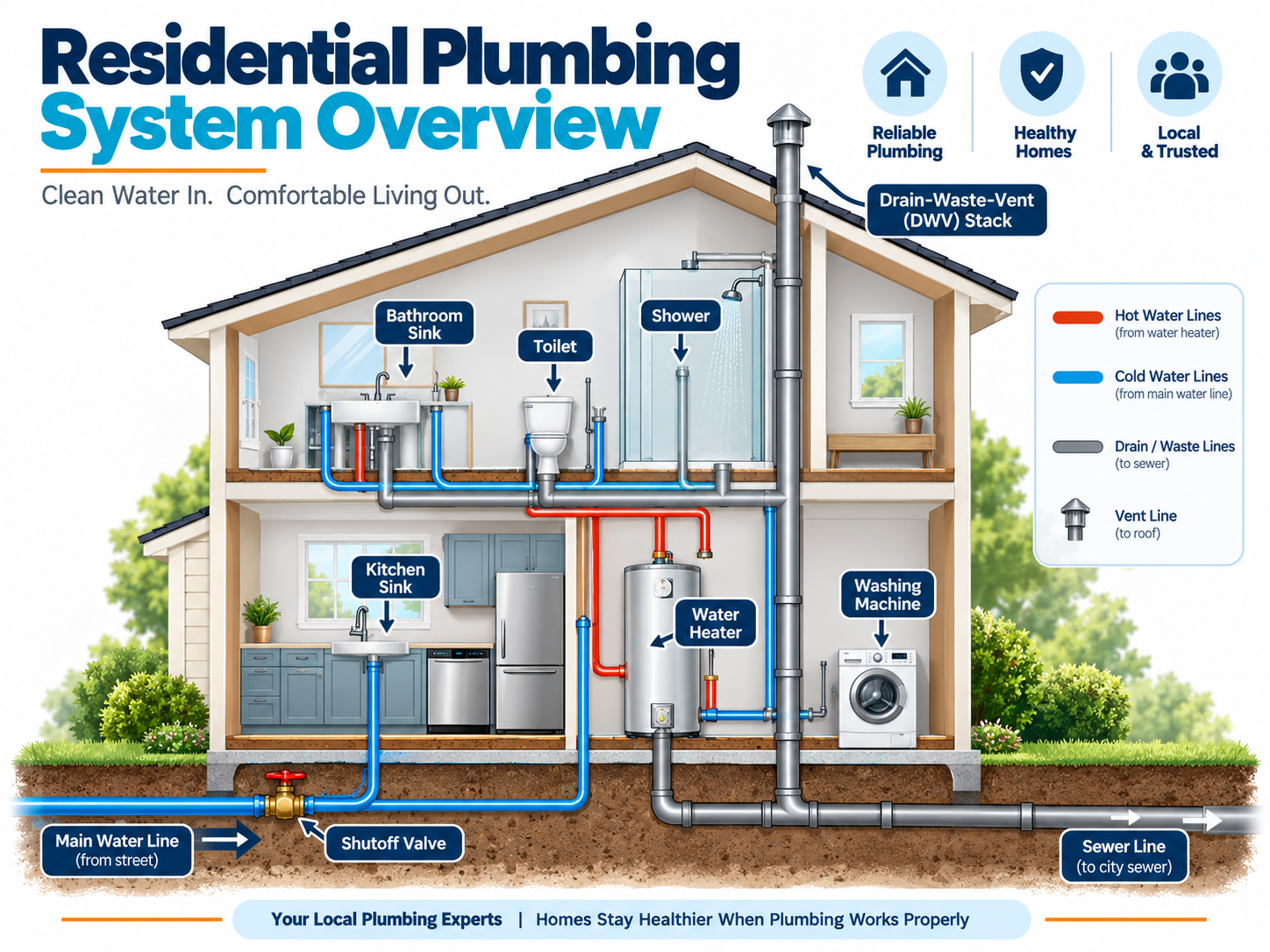
Following the water
Water enters through a single buried supply line, passes the meter, and reaches the main shutoff valve. From there it splits: most of it becomes the cold supply feeding every fixture, and a branch goes into the water heater, which returns it to a parallel network of hot lines.
At each fixture, a pair of supply connections and ideally a pair of stop valves let that fixture be isolated without shutting off the building. Those small valves and flexible connectors are worth knowing about, because they are what you close when something starts leaking under a sink.
The condition of that supply network shows up in two ways. When the piping itself corrodes or scales, flow falls and leaks start appearing in unrelated places, which is where replacing the supply piping enters the conversation. When delivery is weak or unusually forceful without the pipe being at fault, it is a water pressure question settled by measuring at the regulator and the meter first.
Following the waste
On the other side of the fixture, water leaves through a trap, joins a branch drain line, and flows by gravity into progressively larger pipes until it reaches the single sewer line leaving the building. Vents connected to that network let air in so the water moves freely rather than fighting a vacuum.
Because that final run is buried and shared, its condition is hard to judge from inside the building. A camera inspection of the sewer line is how a defect in it gets seen rather than guessed at.
Component by component
What each part does, and what goes wrong with it
Each component below links to the service page covering the problems it produces.
Incoming water line
Water arrives from the utility through a single buried service line, under pressure, past the meter. Everything downstream depends on it, which is why a leak here drops pressure at every fixture at once.
water line repairMain shutoff valve
The one control worth locating before you need it. Closing it stops all water entering the building, which is the first move in most situations where water is escaping.
emergency plumbing stepsCold water supply
From the main, cold water branches to every fixture and appliance, plus the inlet of the water heater. These are the pressurized lines that produce spraying leaks and pinholes when they fail.
pipe repairWater heater
Part of the cold supply diverts into the heater, which stores or heats water and sends it back out through a separate hot line. It is the junction where supply plumbing and equipment meet.
water heater repairHot water supply
A parallel set of lines carries heated water to sinks, tubs, showers, dishwashers, and laundry. Leaks in this network are the ones that leave a warm patch when they run beneath a slab.
slab leak repairFixture supply and stop valves
Each fixture has its own supply connections and, ideally, its own shutoff. Those small valves and connectors are among the most common failure points in a whole house.
faucet and fixture repairTraps
Every drain has a curved trap holding a small amount of water. That water blocks sewer gas from entering the room, which is why an unused fixture eventually starts to smell as its trap dries out.
bathroom plumbingDrain lines
Past the trap, waste water flows by gravity through branch lines that join progressively larger pipes. Slope matters, and a low spot in a horizontal run is where solids settle and blockages form.
drain cleaningVent stack
Vents let air into the drain system so water can flow instead of glugging against a vacuum. A restricted vent produces slow drains and gurgling that look exactly like a clog.
clogged drain helpSewer line
One shared line carries everything from the building to the public sewer. Because it is shared, one problem there affects every fixture simultaneously, which is the signature of a main line issue.
sewer line repairKnow your shutoff
Locate the main water valve, confirm it turns, and make sure everyone in the household knows where it is. It is the single most useful piece of plumbing knowledge you can have.
Watch the meter
With every fixture and appliance off, the meter should be still. Movement means water is leaving the system somewhere, and leak detection starts from exactly that observation.
Respect the vents
Gurgling drains and slow flow across several fixtures often mean air cannot get in, not that something is stuck. It is a different problem with a different fix.
Questions about home plumbing
- Why do drains need vents at all?
- Water flowing down a pipe pulls air behind it. Without a vent path, it pulls that air through the nearest trap instead, which produces gurgling, slow flow, and eventually odor.
- What is the difference between supply and drain plumbing?
- Supply lines are pressurized and carry clean water to fixtures, so failures there spray. Drain lines rely on gravity and carry waste away, so failures there back up or seep.
- Why is one shared sewer line a problem?
- Because everything converges on it. A blockage or defect in that single pipe affects every fixture in the building at once, which is what distinguishes it from an ordinary clog.
- Where is the main shutoff valve usually located?
- Common locations are near the front of the property close to the meter, in a utility area, or on an exterior wall where the supply enters. Finding it on a calm day beats searching during a leak.
- Does water pressure affect the whole system?
- Yes. Excess static pressure stresses every joint, valve, connector, and fill mechanism continuously, which is why high pressure tends to produce repeat failures in different places.
Next: how water heaters work, which covers the one piece of equipment most households interact with daily.
Need plumbing help in Laredo?
Tell us what you're dealing with and your request will be reviewed for availability.